Michael Jordan – The Life and Career of the American Basketball Legend

Michael Jordan – Personal Details and Player Profile
The following table presents the most important personal information and physical details from Michael Jordan’s basketball career.
| Nationality | Date of Birth | Height | Weight | Position | Jersey Number | Shoots |
|---|---|---|---|---|---|---|
| American | February 17, 1963 | 198 cm (6 ft 6 in) | Approx. 98 kg (216 lb) | Shooting Guard / Small Forward | 23 | Right-handed |
Early Life and Introduction to Basketball
Michael Jeffrey Jordan was born in 1963 in Brooklyn, New York, but grew up in Wilmington, North Carolina. He developed a strong interest in sports during childhood and played basketball, baseball, and American football. His parents encouraged discipline, education, and hard work, qualities that later became central to his professional career.
Jordan initially failed to earn a place on the varsity basketball team at Emsley A. Laney High School. Instead of abandoning his ambitions, he used the disappointment as motivation to improve. He trained intensely, grew physically, and became one of the school’s leading players. His performances eventually attracted scholarship offers from several major college basketball programs.
College Career at North Carolina
In 1981, Jordan joined the University of North Carolina and played under legendary coach Dean Smith. As a freshman, he scored the winning basket against Georgetown in the 1982 NCAA Championship game. Jordan later described that shot as the moment when he began developing the confidence that defined his career.
During three seasons with the North Carolina Tar Heels, Jordan became one of the country’s best college players. He was named the national college player of the year in 1984 and averaged 17.7 points per game during his university career. After his junior season, he entered the NBA Draft and was selected third overall by the Chicago Bulls.
Immediate Impact with the Chicago Bulls
Jordan entered the NBA in 1984 and immediately changed the fortunes of the Chicago Bulls. He averaged 28.2 points per game during his first season, earned an All-Star selection, and received the NBA Rookie of the Year award. His spectacular dunks, acrobatic finishes, and fearless attacking style quickly made him one of the league’s biggest attractions.
A serious foot injury limited Jordan during his second season, but he returned in time for the playoffs. In April 1986, he scored 63 points against the Boston Celtics, setting an NBA playoff single-game scoring record. Although Chicago lost the series, Jordan’s performance demonstrated that he could dominate even the league’s strongest teams.
Jordan continued developing into a complete player. In 1988, he won both the NBA Most Valuable Player and Defensive Player of the Year awards. His scoring brilliance was combined with outstanding perimeter defence, quick hands, and an ability to perform at his best in decisive moments.
The First Chicago Bulls Championship Era
The Bulls gradually built a championship team around Jordan, adding players such as Scottie Pippen and Horace Grant. Under head coach Phil Jackson, Chicago introduced the triangle offence and placed greater emphasis on teamwork. The new system allowed Jordan to remain the primary scorer while involving his teammates more effectively.
In 1991, the Bulls defeated the Los Angeles Lakers to win the first NBA championship in franchise history. Jordan was named NBA Finals MVP after averaging 31.2 points per game in the series. Chicago successfully defended the title against the Portland Trail Blazers in 1992 and defeated the Phoenix Suns in 1993.
Jordan won the Finals MVP award after each championship, completing the Bulls’ first three-peat. His 41-point scoring average against Phoenix in the 1993 NBA Finals remains the highest in the history of the series. By this stage, he was the most famous basketball player in the world.
First Retirement and Baseball Career
In October 1993, Jordan unexpectedly announced his retirement from basketball. The decision followed the murder of his father, James Jordan, and years of intense physical and psychological pressure. Jordan then pursued a childhood ambition by attempting to build a professional baseball career.
He signed a minor-league contract with the Chicago White Sox organization and played the 1994 season for the Birmingham Barons. Although he did not reach Major League Baseball, Jordan demonstrated considerable commitment to learning a new sport. His baseball career ended when he decided to return to basketball in 1995.
Return to the NBA and Second Three-Peat
Jordan announced his return with a simple statement: “I’m back.” He initially wore number 45 before returning to his famous number 23. Although the Bulls were eliminated from the 1995 playoffs, the defeat motivated Jordan and his teammates to prepare for another championship run.
During the 1995–96 season, Chicago recorded 72 regular-season victories, which was an NBA record at the time. The Bulls defeated the Seattle SuperSonics in the NBA Finals, and Jordan won the regular-season MVP, All-Star Game MVP, and Finals MVP awards.
Chicago captured two additional championships by defeating the Utah Jazz in the 1997 and 1998 NBA Finals. Jordan’s winning shot over Bryon Russell in Game 6 of the 1998 Finals became one of the most iconic moments in basketball history. He completed his Bulls career with six NBA championships and six Finals MVP awards.
Final Comeback with the Washington Wizards
Jordan retired for a second time in 1999 but remained involved in basketball as an executive and part-owner of the Washington Wizards. In 2001, at the age of 38, he returned to the court and played two seasons for the franchise.
Although he was no longer as explosive as during his prime, Jordan still produced several impressive performances. In December 2001, he scored 51 points against the Charlotte Hornets, while in 2003 he became the first 40-year-old NBA player to score at least 40 points in a game.
Jordan played his final NBA game on April 16, 2003, against the Philadelphia 76ers. He left the court to a prolonged standing ovation from players, coaches, and supporters, bringing one of the most celebrated careers in sports history to an end.
International Career with the United States
Jordan represented the United States at several international tournaments and never lost a game while playing for the national team. He won gold at the 1983 Pan American Games before leading the United States in scoring during its gold-medal campaign at the 1984 Olympic Games in Los Angeles.
His most famous international appearance came at the 1992 Barcelona Olympics as a member of the original “Dream Team.” The squad included Magic Johnson, Larry Bird, Charles Barkley, Karl Malone, and several other NBA legends. Jordan started every game as the United States dominated the tournament and won the gold medal.
The Dream Team helped popularize basketball throughout the world and inspired generations of international players. Jordan’s presence, performances, and global fame made him one of the central figures in this transformation.
Playing Style and Competitive Mentality
Jordan combined exceptional athletic ability with outstanding technical skill and basketball intelligence. Early in his career, he was best known for explosive drives, spectacular dunks, and his ability to remain in the air while avoiding defenders. His jumping ability earned him the nicknames “Air Jordan” and “His Airness.”
As Jordan became older, he developed an effective post-up game, turnaround jump shot, and fadeaway jumper. These skills allowed him to continue scoring against younger and more athletic defenders. He was equally influential at the defensive end, earning nine selections to the NBA All-Defensive First Team.
Jordan’s competitive mentality became as famous as his physical abilities. He constantly searched for additional motivation and demanded high standards from himself and his teammates. His confidence in important moments made him one of the most feared clutch performers in basketball history.
Awards, Records and Achievements
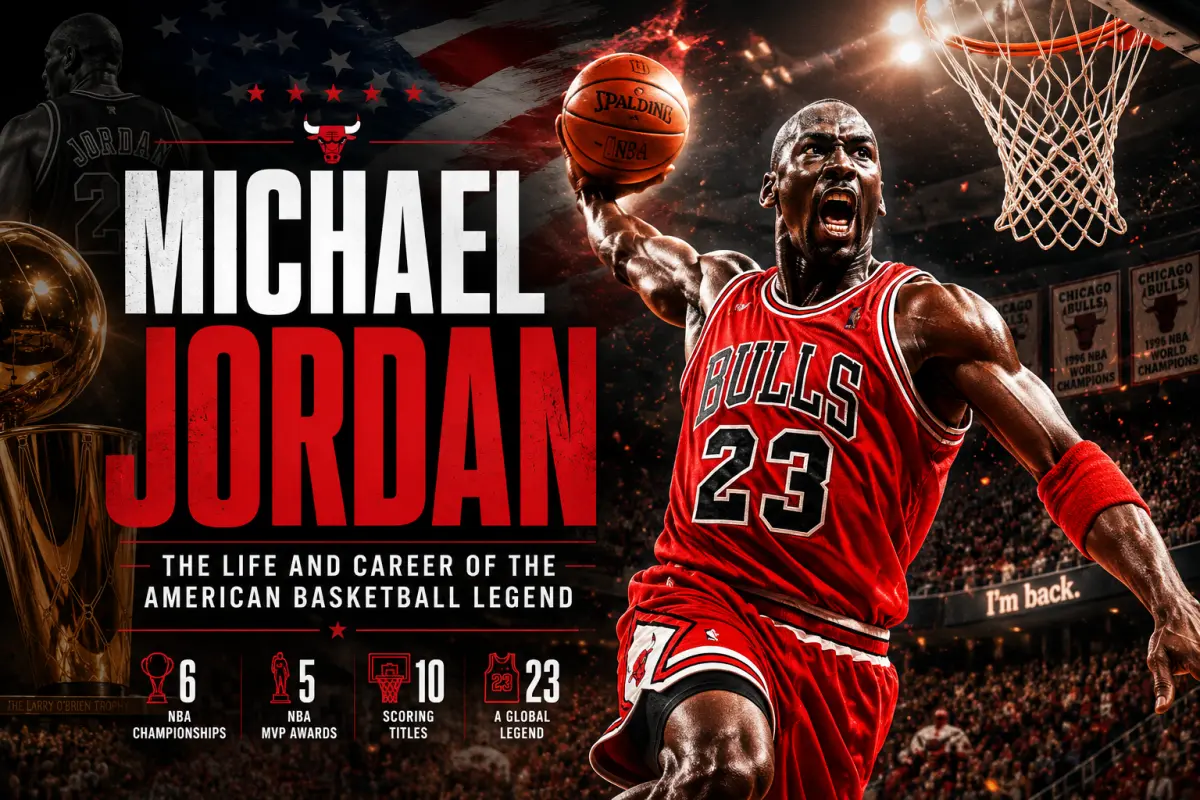
Jordan won six NBA championships, six NBA Finals MVP awards, and five regular-season MVP awards. He was selected for 14 NBA All-Star Games, won ten scoring titles, and was named to the All-NBA First Team ten times. He also received the NBA Defensive Player of the Year award in 1988.
He completed his regular-season career with 32,292 points, 6,672 rebounds, and 5,633 assists. His average of 30.1 points per regular-season game remains the highest in NBA history, while his playoff average of 33.4 points per game is also a league record.
Jordan was inducted into the Naismith Memorial Basketball Hall of Fame in 2009. He was inducted again in 2010 as a member of the 1992 United States Olympic Dream Team. The NBA later named its regular-season MVP award the Michael Jordan Trophy in recognition of his historic influence.
Private Life, Business and Global Influence
Jordan’s influence extended far beyond the basketball court. His partnership with Nike led to the creation of the Air Jordan line, which became one of the most successful and recognizable brands in sportswear history. His shoes, clothing, advertisements, and personal image helped transform the commercial possibilities available to professional athletes.
Jordan also appeared in the 1996 film “Space Jam,” introducing him to an even wider international audience. Following his playing career, he became involved in business, investments, motorsports, and professional sports ownership. He served as the majority owner of the Charlotte Hornets before selling his controlling interest in the franchise in 2023.
Through charitable donations and community projects, Jordan has supported medical care, education, social justice initiatives, and organizations assisting disadvantaged children. His combination of sporting achievement, commercial success, and cultural influence remains unique.
NBA Career Statistics
The following table summarizes Jordan’s regular-season statistics for the Chicago Bulls and Washington Wizards.
| Years | Team | Games | Points | Rebounds | Assists |
|---|---|---|---|---|---|
| 1984–1993, 1995–1998 | Chicago Bulls | 930 | 29,277 | 5,836 | 5,012 |
| 2001–2003 | Washington Wizards | 142 | 3,015 | 836 | 621 |
| NBA Career Total | 1,072 | 32,292 | 6,672 | 5,633 | |
International Career Statistics
This table presents Jordan’s performances in the major official tournaments he played with the United States national team.
| Year | Team | Tournament | Games | Points per Game | Result |
|---|---|---|---|---|---|
| 1983 | United States | Pan American Games | 8 | 17.3 | Gold Medal |
| 1984 | United States | Summer Olympics | 8 | 17.1 | Gold Medal |
| 1992 | United States | Tournament of the Americas | 6 | 12.7 | Gold Medal |
| 1992 | United States | Summer Olympics | 8 | 14.9 | Gold Medal |
Michael Jordan’s journey from North Carolina to worldwide superstardom is a testament to talent, discipline, determination, and competitive ambition. His six championships with the Chicago Bulls, individual records, unforgettable performances, and international success established him as a basketball icon. Beyond the court, the Air Jordan brand and his global cultural influence changed the relationship between sport, entertainment, and business. His career continues to inspire athletes and basketball fans around the world.