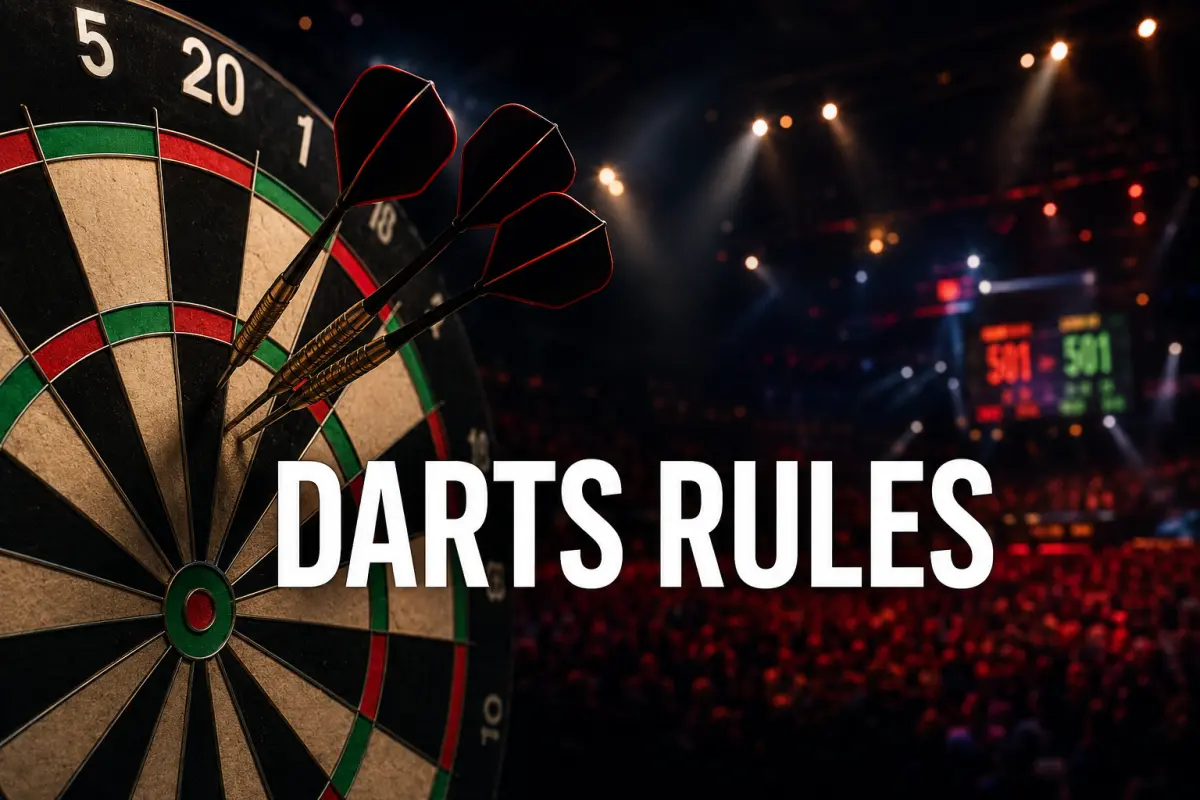
🎯 Professional Darts Rules, Scoring System and Match Formats Explained
Professional darts is a precision sport in which players throw three steel-tip darts per visit at a regulation board. The best-known discipline is 501, played on the PDC circuit and at major televised tournaments. Although the objective is simple, elite matches demand arithmetic, consistency, nerve and intelligent route selection.
🏆 How Competitive Darts Matches Work from First Throw to Final Checkout
In professional steel-tip darts, the board’s bullseye is positioned 1.73 metres above the floor, while the oche—the throwing line—is 2.37 metres from the face of the board. A player must keep at least part of one foot behind the oche while throwing. A leg normally begins at 501 points, though some events also use formats such as 301 or 701.
Each player throws up to three darts per turn, called a visit, and the scored value is deducted from the starting total. The inner narrow ring is a treble worth three times the number, while the outer narrow ring is a double worth twice the number. The outer bull scores 25 and the central bullseye scores 50.
🔢 The 501 Scoring System in Professional Darts
A perfect visit is 180: three darts in the treble 20, the highest-value segment on the board. Players usually target treble 20 because it offers the greatest scoring potential, but they may switch to treble 19, 18 or another segment when blocked by previous darts. High scoring creates opportunities to finish a leg in fewer visits.
Only darts that remain in the board when the player has completed the visit count. A dart that falls out, bounces off the wire or misses the board scores nothing, even if it briefly touched a scoring area. Professional players therefore need both scoring power and tight grouping, especially when attempting three darts at a narrow treble bed.
✅ Double-Out Rules and the Importance of Finishing
In standard PDC-style 501, a player must reach exactly zero by hitting a double or the bullseye, which counts as a double 25. This is called double-out. For example, a player on 40 can win the leg with double 20, while a player on 32 may choose double 16 to leave a familiar target.
If a player reduces the score below zero, leaves one point, or reaches zero without a valid finishing double, the visit is a bust. No points from that entire visit are deducted, and the score returns to what it was before the turn started. This rule makes checkout calculation one of the defining skills in professional darts.
📊 Legs, Sets and Tournament Match Formats
A leg is one complete game from 501 down to zero, and a match is usually decided by a required number of legs. A short-format contest may be played over the best of 11 legs, meaning the first player to six wins. Longer ranking events can require many more legs and often reward endurance as well as quality.
Some prestigious tournaments use a set format instead. A set contains a fixed number of legs, commonly best of five, and the player who wins enough sets takes the match. Sets can create dramatic momentum changes because a player may dominate one section of a match yet still need to reset quickly for the next one.
🎲 Starting Order, Deciding Legs and Match Etiquette
The starting player is commonly determined by a bull-off before the match, with each competitor throwing one dart at the bull. The player closest to the centre earns the advantage of throwing first, although exact procedures can vary by event. Players then alternate the throw at the start of successive legs under the tournament’s designated order.
If a deciding leg is required, professional events may use the established throwing order or another bull-off, depending on the competition rules. Players must not cross the oche, distract an opponent or retrieve darts before the score has been confirmed. Respect for rhythm, scoring accuracy and the referee is an essential part of elite darts.
🎯 Why Professional Darts Is More Than Hitting the Bullseye
Professional darts rewards repeatable technique, calm decision-making and the ability to perform under pressure. The bullseye is valuable, but it is not the main target during ordinary scoring because treble 20 produces more points. Matches are often decided by whether a player converts a checkout chance rather than by who throws the most 180s.
Understanding the rules also makes televised darts far easier to follow. Every visit has a strategic purpose: score heavily, leave a preferred finish, pressure the opponent or close the leg with a double. That blend of mathematical planning and split-second execution is what turns a pub game into a demanding professional sport.
Professional darts is built around a clear 501 scoring system, but the double-out rule gives every leg a tense finish. Players must combine high scoring with precise checkout routes and emotional control. Once the rules are understood, every treble, missed double and winning dart becomes far more meaningful.