🏒 How to Master Faceoffs and Win More Draws in EA Sports NHL [VIDEO]
Winning faceoffs in EA NHL is about much more than moving the analog stick faster than your opponent. The game combines grip selection, counters, timing, player attributes, and tactical decision-making. This guide explains the system presented by Sleeveless Gaming and turns the accompanying faceoff chart into practical advice.
🎮 Understanding the EA NHL Faceoff System
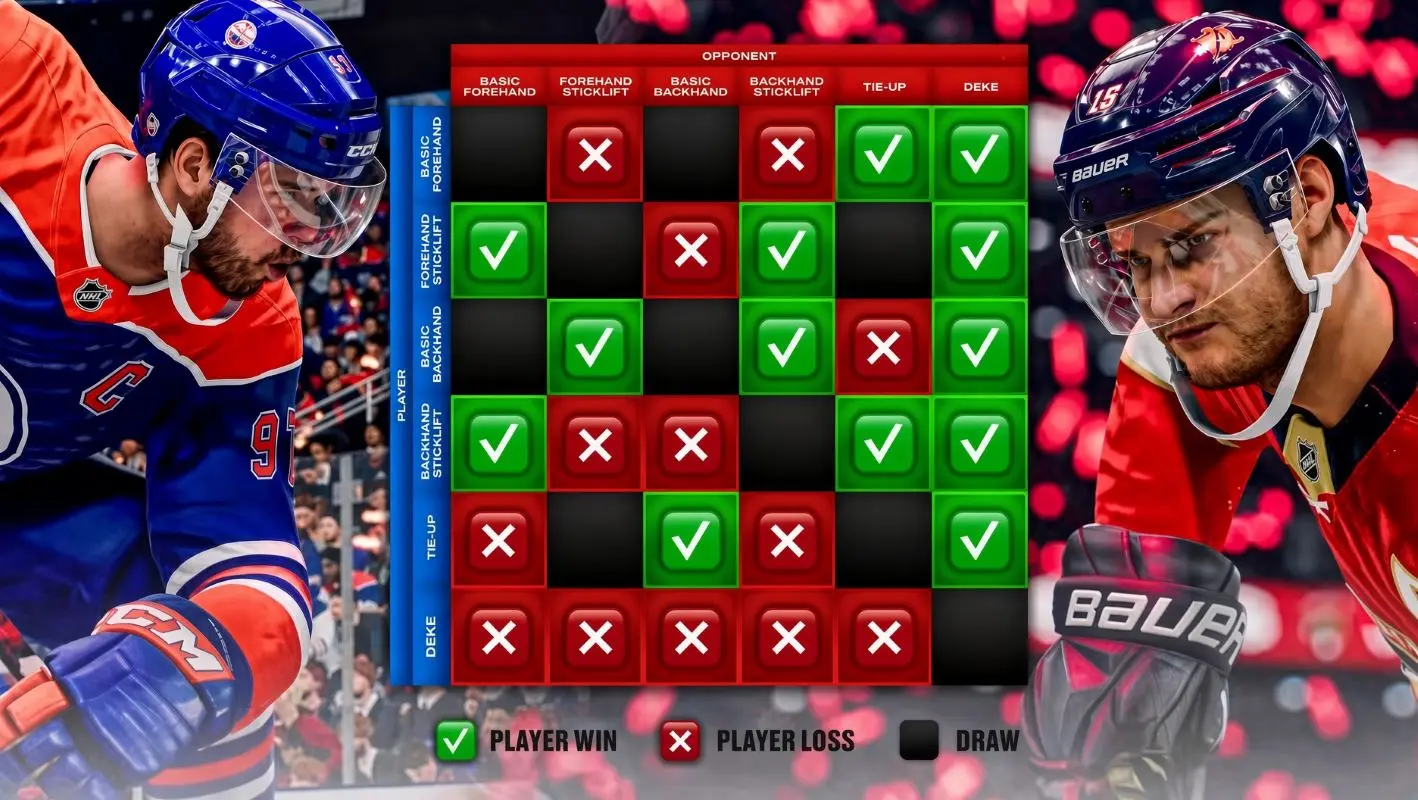
Every faceoff begins with two decisions: which grip to select and which move to perform when the referee releases the puck. The available actions include basic forehand and backhand draws, stick lifts, tie-ups, and a faceoff deke. Each move has favorable and unfavorable matchups, creating a system similar to rock-paper-scissors.
Timing still matters, particularly when both players select moves that lead to a neutral matchup. The Faceoffs attribute can then give one center an advantage, while connection quality may influence online execution. Consistent success therefore requires a combination of mechanical skill, matchup knowledge, and the ability to recognize an opponent’s habits.
🕹️ EA NHL Faceoff Controls and Grip Selection
Before the puck drops, move the right stick to choose a forehand or backhand grip and hold it there. The correct side depends on whether the center shoots left or right, so watch the on-screen animation rather than memorizing one universal direction. Set the grip early; a late input may fail to register or spoil your timing.
Once the referee begins the drop, roll or flick the right stick downward for a basic win, upward for a stick lift, or push the left stick up for a tie-up. The right-stick motion starts from the selected grip. A faceoff deke is a separate, high-risk option, and its exact modifier should be checked against the control preset used on your platform.
🔄 Which Faceoff Moves Counter Each Other?
The most useful rule is a three-way cycle: a basic backhand beats a backhand stick lift, the backhand stick lift beats a tie-up, and the tie-up beats a basic backhand. This is the foundation of Sleeveless Gaming’s approach. When opponents repeat one option, stop trying to be merely faster and select the move designed to defeat it.
Forehand interactions add another layer. A forehand stick lift beats a basic forehand and a backhand stick lift, while a basic forehand defeats a tie-up. According to the supplied counter chart, basic backhand also beats forehand stick lift. Identical or neutral pairings can become draws decided by ratings, timing, and puck support.
⏱️ How to Improve Faceoff Timing in EA NHL
Watch the referee’s hand and execute as the puck release begins, not while everyone is still set. Moving too early can lock you into a poor attempt, while reacting late gives away the draw even with the correct counter. Online latency can shift how the window feels, so use a wired connection when possible and calibrate your reaction in actual matches.
Timing does not replace the counter system; it separates players when the selected moves do not produce an automatic win or loss. Avoid frantic stick flicks, because extra inputs make your action less repeatable. Practice one clean motion from each grip, then add the tie-up and stick lifts until you can perform them without looking at the controller.
⭐ How Faceoff Ratings Affect Your Chances of Winning
The Faceoffs attribute matters most when the matchup reaches a neutral result, such as both centers using the same basic draw. A superior rating improves consistency and can forgive a less exact reaction. In HUT, prioritize natural centers with strong faceoff ratings; in World of CHEL, do not neglect the faceoff attribute when building a center.
Ratings cannot rescue a move that is hard-countered, which is why a weaker center can still beat a star through the right choice. Treat attributes as a tiebreaker and margin for error, not permission to repeat one animation. If two suitable centers are available, place the better faceoff player on the line that takes the most important draws.
🧠 Reading Opponents and Building a Faceoff Strategy
Read patterns by grip, score, zone, and previous choices. If an opponent repeatedly pulls straight back, answer with a tie-up; if they counter that tie-up with a backhand stick lift, return to the basic backhand. Do not switch randomly after every loss. Change because you identified the move, then remember how the opponent reacted to your adjustment.
Situational risk matters as much as the win percentage. In your defensive zone, choose a counter and formation that avoid an immediate chance if you lose; in the offensive zone, coordinate a tie-up with the winger or direct a clean win toward a prepared shooter. Mix options, track outcomes, and use faceoffs to begin a planned play rather than a scramble.
There is no single faceoff move that wins every possible matchup in EA NHL. The most reliable method is to master the basic backhand, stick lift, and tie-up cycle before adding forehand options and risky dekes. With accurate timing and careful observation, faceoffs become a strategic advantage instead of a guessing game.



![EA Sports FC 27 Reveal Trailer [VIDEO]](https://livesports.co/wp-content/uploads/thumbs_dir/EA-Sports-FC-27-Reveal-Trailer-252pchs9f7le3xsgpl3xgfdn2tp6xdip3jwniy9yjiqs.webp)