Wayne Gretzky – The Life and Career of the Canadian Ice Hockey Legend

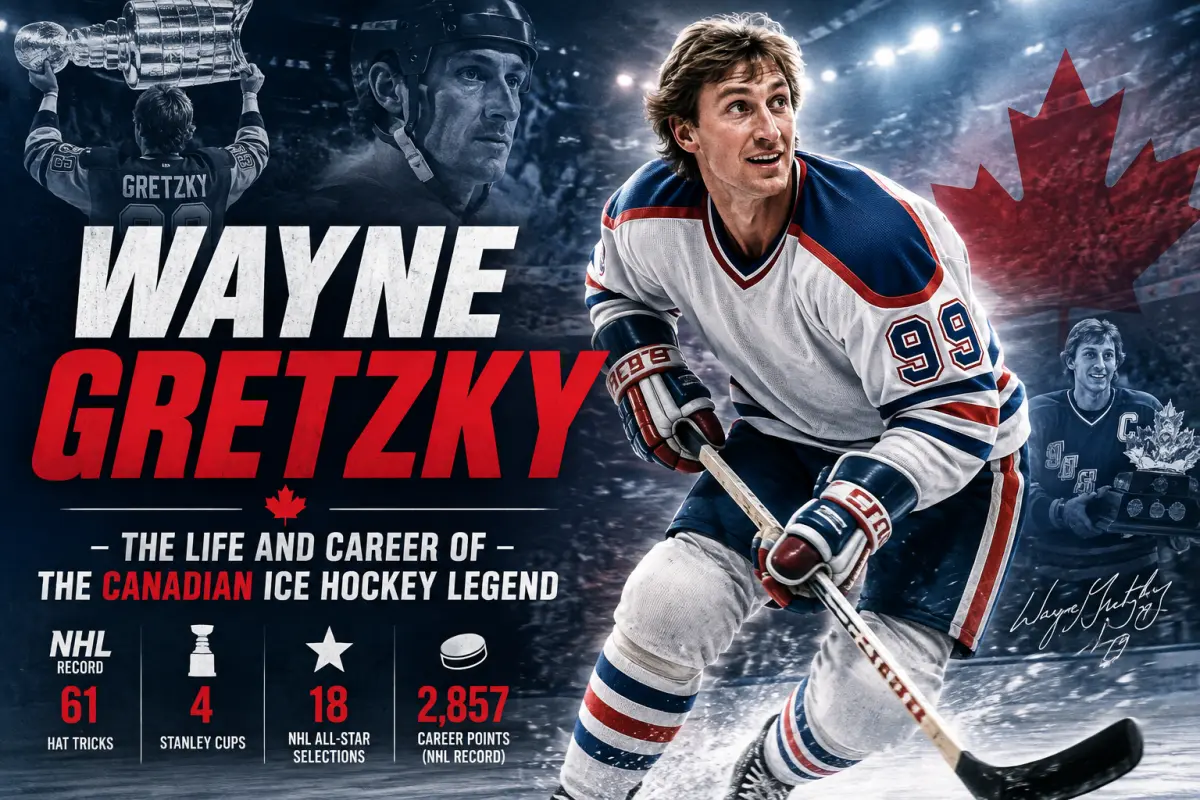
Wayne Gretzky is widely regarded as the greatest ice hockey player in the history of the sport. Nicknamed “The Great One,” he transformed professional hockey through his extraordinary vision, intelligence, passing ability, and unmatched scoring production. His journey from a backyard rink in Ontario to global sporting fame remains one of the most remarkable stories in ice hockey.
Wayne Gretzky – Personal Details and Player Profile
The following table presents the most important personal information and physical details from Wayne Gretzky’s playing career.
| Nationality | Date of Birth | Height | Weight | Position | Jersey Number | Shoots |
|---|---|---|---|---|---|---|
| Canadian | January 26, 1961 | 183 cm (6 ft 0 in) | Approx. 84 kg (185 lb) | Centre | 99 | Left |
Early Life and Beginnings
Wayne Douglas Gretzky was born in 1961 in Brantford, Ontario, Canada. He developed a fascination with ice hockey at an exceptionally young age, learning the game on a backyard rink built by his father, Walter Gretzky. The rink, known within the family as the “Wally Coliseum,” became the place where Wayne spent countless hours practising skating, shooting, and puck control.
Gretzky regularly competed against children several years older than him and quickly attracted attention because of his extraordinary understanding of the game. He was not the largest or strongest player on the ice, but his anticipation allowed him to react before his opponents. After dominating minor hockey, he played junior hockey for the Sault Ste. Marie Greyhounds, where he adopted the number 99 that would become permanently associated with his career.
Professional Debut in the WHA
Because NHL regulations did not allow teams to sign players under the age of 20, the teenage Gretzky began his professional career in the World Hockey Association. In 1978, he joined the Indianapolis Racers at only 17 years old. Financial difficulties soon forced the Racers to sell his contract to the Edmonton Oilers, a move that would change the history of the franchise.
Gretzky immediately demonstrated that his talent could succeed against experienced professionals. During the 1978–79 WHA season, he recorded 110 points in 80 regular-season games split between Indianapolis and Edmonton. When the WHA ceased operations in 1979, the Oilers entered the NHL and were able to retain their young superstar.
Rise to Stardom with the Edmonton Oilers
Gretzky became one of the NHL’s leading players during his first season with the Edmonton Oilers. He recorded 137 points in 79 games and won the Hart Memorial Trophy as the league’s most valuable player. It was the beginning of an era in which Gretzky produced offensive numbers previously thought to be impossible.
In the 1981–82 season, he scored 92 goals, setting a single-season NHL record that still stands. Four years later, he established another historic record by collecting 215 points in one season. Gretzky possessed an extraordinary ability to read the movement of every player on the ice, while his precise passing made his teammates more dangerous.
Edmonton developed into the dominant NHL team of the 1980s, featuring stars such as Mark Messier, Jari Kurri, Paul Coffey, Glenn Anderson, and Grant Fuhr. With Gretzky as its offensive leader, the club won four Stanley Cup championships in 1984, 1985, 1987, and 1988. He also received the Conn Smythe Trophy as the most valuable player of the playoffs in 1985 and 1988.
Historic Trade to the Los Angeles Kings
In August 1988, the Edmonton Oilers traded Gretzky to the Los Angeles Kings in one of the most famous transactions in sports history. The announcement shocked Canadian hockey supporters, while an emotional Gretzky struggled to speak during the press conference. The deal became known simply as “The Trade” and marked the end of Edmonton’s greatest era.
Gretzky’s arrival transformed the position of ice hockey in Southern California. He immediately made the Kings competitive, won another Hart Memorial Trophy, and helped attract new supporters to the sport. His popularity contributed to the growth of hockey across non-traditional American markets and encouraged the NHL’s later expansion into several southern and western cities.
The greatest team achievement of his time in Los Angeles came in 1993, when he led the Kings to their first Stanley Cup Final. Although the team lost the series to the Montreal Canadiens, the playoff run became one of the defining moments in franchise history. Gretzky remained the face of the Kings until 1996.
St. Louis Blues and New York Rangers
In February 1996, Gretzky was traded to the St. Louis Blues. His stay in Missouri was brief, but it gave him an opportunity to play alongside another great NHL scorer, Brett Hull. Gretzky recorded 21 points in 18 regular-season games and added 16 points during the playoffs before becoming a free agent.
Later that year, he signed with the New York Rangers and reunited with former Edmonton teammate Mark Messier. During his first season in New York, Gretzky helped the Rangers reach the Eastern Conference Final. He continued to be an outstanding playmaker during his final years, recording 249 points in 234 regular-season games for the club.
Gretzky played the last game of his professional career on April 18, 1999, at Madison Square Garden. The emotional occasion celebrated a player whose achievements had changed ice hockey forever. Fittingly, the final point of his career came from an assist.
International Career with Canada
Gretzky represented Canada at several major international tournaments, including the World Junior Championship, World Championship, Canada Cup, World Cup of Hockey, and Winter Olympics. His most memorable international performances came in the Canada Cup, where he helped his country win championships in 1984, 1987, and 1991.
The 1987 Canada Cup is particularly remembered for Gretzky’s partnership with Mario Lemieux. In the decisive game against the Soviet Union, Gretzky assisted Lemieux’s late winning goal, creating one of the most famous moments in Canadian hockey history. Gretzky finished that tournament with 21 points in only nine games.
His final international appearance as a player came at the 1998 Winter Olympics in Nagano. Although Canada did not win a medal, Gretzky’s presence gave the tournament enormous significance. He later served as executive director of the Canadian men’s team that won Olympic gold in Salt Lake City in 2002.
Playing Style and Hockey Intelligence
Gretzky’s dominance did not depend on exceptional size, physical strength, or an especially powerful shot. His greatest advantages were anticipation, creativity, balance, and an almost unmatched awareness of the action around him. He appeared to know where the puck and every player would be several seconds before a play developed.
He became particularly dangerous behind the opposition’s net, an area that became known as “Gretzky’s office.” From there, he could protect the puck, draw defenders out of position, and deliver passes to teammates moving into scoring areas. Opponents often knew what he intended to do but were still unable to prevent it.
Gretzky was also an elite goal scorer, but his playmaking ability distinguished him from other superstars. His career total of 1,963 NHL assists is so remarkable that he would remain the league’s all-time points leader even if all 894 of his goals were removed from his record.
Records, Awards and Achievements
Gretzky completed his NHL career with 894 goals, 1,963 assists, and 2,857 points in 1,487 regular-season games. Although Alexander Ovechkin later surpassed his regular-season goals record, Gretzky remains the NHL’s all-time leader in assists and total points. His extraordinary production established a standard that no other player has approached.
He won the Hart Memorial Trophy nine times, including eight consecutive awards between 1980 and 1987. Gretzky also captured the Art Ross Trophy as the NHL’s leading scorer on ten occasions and received five Lady Byng Memorial Trophies. His four Stanley Cup championships and two Conn Smythe Trophies further demonstrate his impact in the most important games.
Gretzky was inducted into the Hockey Hall of Fame in 1999 without the usual waiting period. In 2000, the NHL retired his number 99 across the entire league, making him the only player to receive that honour. No NHL player can wear the number again.
Private Life and Activities Beyond the Ice
Away from hockey, Gretzky has remained one of Canada’s most recognizable public figures. He married actress Janet Jones in 1988, and the couple have five children. Members of the Gretzky family have been active in sports, entertainment, and business, while Wayne has generally maintained a respected and family-oriented public image.
Following his retirement, Gretzky became involved in team ownership, broadcasting, charitable projects, and business ventures. He has supported numerous causes connected with children, health care, and youth hockey. His commercial influence has included restaurants, sports memorabilia, endorsements, and other investments.
Gretzky has also worked as an NHL television analyst, sharing his knowledge with a new generation of hockey supporters. Despite his enormous fame, he has frequently credited his teammates, coaches, and family for helping him build his career.
NHL and WHA Club Career Statistics
The table summarizes Gretzky’s regular-season performances for every professional team he represented in the WHA and NHL.
| Years | Team | League | Games | Goals | Assists | Points |
|---|---|---|---|---|---|---|
| 1978 | Indianapolis Racers | WHA | 8 | 3 | 3 | 6 |
| 1978–1979 | Edmonton Oilers | WHA | 72 | 43 | 61 | 104 |
| 1979–1988 | Edmonton Oilers | NHL | 696 | 583 | 1,086 | 1,669 |
| 1988–1996 | Los Angeles Kings | NHL | 539 | 246 | 672 | 918 |
| 1996 | St. Louis Blues | NHL | 18 | 8 | 13 | 21 |
| 1996–1999 | New York Rangers | NHL | 234 | 57 | 192 | 249 |
| NHL Career Total | 1,487 | 894 | 1,963 | 2,857 | ||
International Career Statistics
This table presents Gretzky’s performances for Canada in the most important official international tournaments of his career.
| Year | Team | Tournament | Games | Goals | Assists | Points |
|---|---|---|---|---|---|---|
| 1978 | Canada U20 | World Junior Championship | 6 | 8 | 9 | 17 |
| 1981 | Canada | Canada Cup | 7 | 5 | 7 | 12 |
| 1982 | Canada | World Championship | 10 | 6 | 8 | 14 |
| 1984 | Canada | Canada Cup | 8 | 5 | 7 | 12 |
| 1987 | Canada | Canada Cup | 9 | 3 | 18 | 21 |
| 1991 | Canada | Canada Cup | 7 | 4 | 8 | 12 |
| 1996 | Canada | World Cup of Hockey | 8 | 3 | 4 | 7 |
| 1998 | Canada | Winter Olympics | 6 | 0 | 4 | 4 |
Coaching Career with the Phoenix Coyotes
Gretzky became a managing partner of the Phoenix Coyotes after his retirement and was appointed the team’s head coach in 2005. He remained behind the bench for four NHL seasons, attempting to transfer his exceptional knowledge of the game into coaching. The Coyotes showed periods of improvement but did not qualify for the Stanley Cup Playoffs during his tenure.
His overall regular-season coaching record was 143 wins, 161 losses, and 24 overtime or shootout losses in 328 games. Gretzky stepped down in 2009 amid uncertainty surrounding the franchise’s ownership and financial situation. Although his coaching career did not match the extraordinary success of his playing days, it represented another important chapter in his long involvement with professional hockey.
Wayne Gretzky’s journey from a backyard rink in Brantford to the summit of professional hockey is a story of talent, intelligence, dedication, and imagination. His achievements with the Edmonton Oilers, Los Angeles Kings, Canadian national team, and other clubs established him as the defining player of his generation. More importantly, he changed how ice hockey was played, understood, and promoted around the world. “The Great One” remains not only a Canadian sporting hero but also the most influential figure in the history of the NHL.